

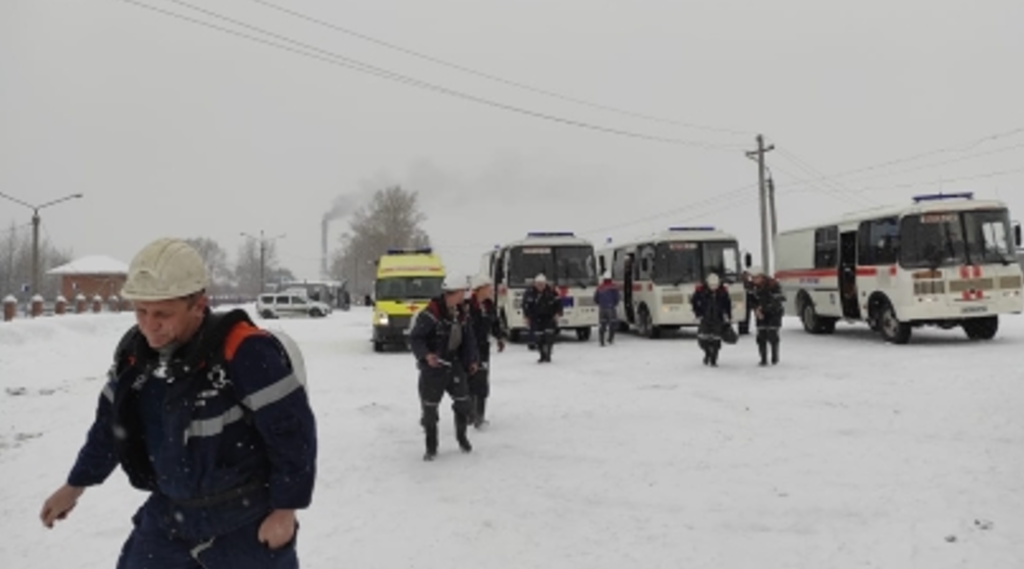
An explosion killed 51 people and injured 49 at the Listvyazhnaya coal mine in Russia’s Kemerovo region on November 25. There were 285 miners in the mine when the incident occurred, and 46 of them were killed by the explosion. Five rescuers also died of asphyxiation after entering the mine to retrieve bodies and help trapped miners.
Russia’s Investigative Committee for the Kemerovo region said investigators detained the first deputy and site manager of the Listvyazhnaya mine for violating industrial safety requirements for hazardous production facilities.
The incident occurred after a mine shaft was filled with gas, likely methane, which then ignited around 08:35 local time. The Listvyazhnaya mine is located about 2175 miles (3500 km) east of Moscow. Russia’s Emergencies Ministry (EMERCOM) said 285 people were inside the mine at the time of the explosion and that 239 were able to reach the surface. The official death toll was initially reported as 11, while 35 miners were said to be missing. A total of 49 people required treatment in the hospital, mainly due to smoke inhalation. Four of the injured were said to be in serious condition.
A rescue operation was launched in the afternoon, with several rescue teams entering the mine. The operation was halted when high levels of methane were detected in the mine, however, a team of six rescuers was unable to leave the mine. The bodies of three rescuers were later recovered, while three more were still missing. Rescue operations were suspended until the morning of November 26, when one of the missing rescuers emerged alive from the mine. He was rushed to hospital with moderate carbon monoxide poisoning, EMERCOM said. It was confirmed that the two remaining rescuers had died, probably from asphyxiation.
As part of a site visit, the acting head of EMERCOM rescue teams Alexander Chupriyan continues to take air samples at the mine to determine the level of risk. “Mine inspection is a long process. Now it is necessary to displace the oxygen in the mine to avoid a second explosion,” Chupriyan said. He also emphasized that rescue teams will find the best solution to continue search operations.
On 26 November, Chupriyan confirmed that all the missing miners had died. “On November 25, the tragedy at the Listvyazhnaya mine in the Kemerovo region claimed the lives of 51 people. At the time of the accident, there were 285 miners in the mine. It was possible to get 239 people out of the mine. Unfortunately, 46 miners died. During the search and rescue operations, 5 mining rescuers from the Paramilitary Mining Rescue Unit of the Russian Ministry of Emergency Situations were killed. Mine rescuers, like miners, did their duty to the end. We mourn immensely for the dead miners and rescuers. This is a great tragedy for the whole country and for the Russian Ministry of Emergencies. On my own behalf and on behalf of the entire EMERCOM team from Russia, I express my deepest condolences to the families and friends of the dead miners and rescuers.
Functional safety measures that could have helped
- Gas Detection and Automatic Shutdown Systems Continuous monitoring for methane and carbon monoxide, with automatic ventilation activation or power cut-off when thresholds are exceeded, is a cornerstone of IEC 61508-based safety systems.
- Redundant Ventilation Controls Functional safety demands fail-safe design. Redundant fans and airflow sensors could ensure methane is diluted below explosive limits even if one system fails.
- Explosion-Proof Equipment and Zoning Proper classification of hazardous zones and use of intrinsically safe equipment reduces ignition risks — a key layer in safety integrity level (SIL) planning.
- Emergency Response Automation Functional safety systems can trigger alarms, initiate evacuation protocols, and activate suppression systems (e.g., water sprays or chemical barriers) automatically when danger is detected.
- Safety Lifecycle Management Applying the full safety lifecycle — from hazard analysis to validation — ensures that systems are not only designed safely, but also maintained and tested regularly.
Standards that apply
- IEC 61508 – The foundational standard for functional safety of electrical/electronic/programmable systems.
- IEC 61511 – Tailored for process industries, but its principles can be adapted to mining operations.
- ISO 13849 – Useful for mechanical safety systems, such as conveyor belts and ventilation dampers.
How Industrial Cybersecurity could have helped?
- Real-Time Monitoring & Alerting Secure sensor networks could continuously monitor methane levels, ventilation status, and equipment health — with alerts sent to operators and safety systems before thresholds are breached.
- Secure Remote Access Controls Preventing unauthorized changes to ventilation or gas detection systems through strong authentication, role-based access, and network segmentation.
- Anomaly Detection & Threat Response Cybersecurity tools using behavioral analytics could detect abnormal patterns (e.g., sensor tampering, data spoofing, or system overrides) and trigger automated safety protocols.
- Resilient Communication Networks Hardened OT networks ensure that critical safety data (like gas levels or fan status) is reliably transmitted, even during cyber or physical disruptions.
- Defense-in-Depth Architecture Layered security — including firewalls, intrusion detection, and unidirectional gateways — protects control systems from ransomware or sabotage that could disable safety mechanisms.
Why it matters?
Modern mines rely on interconnected control systems for ventilation, gas detection, and power. If these systems are compromised — whether by accident, malware, or poor configuration — the consequences can be catastrophic. Cybersecurity ensures these systems remain available, accurate, and trustworthy when lives depend on them.
Source: Link


Get Involved & Participate!
Comments