
From Systems to People: Enabling Safety & Security in Daily Industrial Performance
In industrial environments, safety and security is more than a goal—it’s a condition that must be actively maintained. While systems and technologies are essential, true operational safety depends on continuous support, smart strategies, and well-informed teams.
Supporting safe plant operation and secure systems means being present—not just during incidents or audits, but every day, every shift, every decision. Security Functions must be maintained and available all the time. If security is not available, it won’t work. Security functions are designed based on the results of the risk assessment. Changes in zones and conduits will require changes in security strategies and functions as well.
Safety & Security as a Living Process
Safety is often thought of in terms of compliance: training completed, PPE worn, interlocks in place. But in reality, plant safety lives in operations—in how people respond, how systems behave, security functions, security strategies, and how information flows.
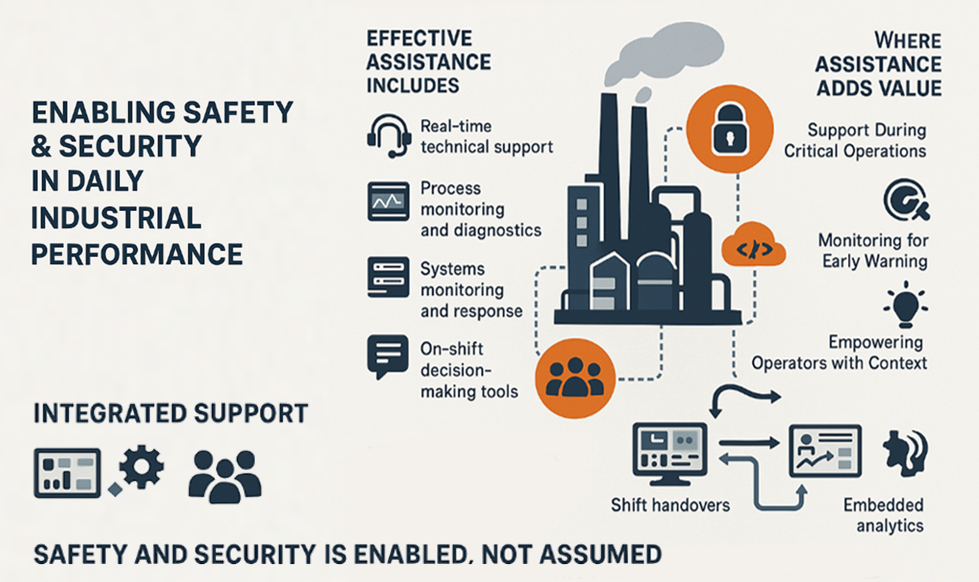
Effective assistance to safe operations includes:
- Real-time technical support
- Process monitoring and diagnostics
- On-shift decision-making tools
- Continuous risk communication
It’s not just about avoiding incidents—it’s about enabling better choices at the operational level, preventing consequences.
Where Assistance Adds Value
- Support During Critical Operations
Startups, shutdowns, maintenance windows, or process upsets all carry higher risk. Having immediate access to engineering support, historical data, and escalation protocols can prevent minor deviations from becoming major events.
- Assess, Mitigate, and Monitor for Early Actions
Assisting safe operation means watching before things go wrong. This includes:
- Mitigate the risk to make sure that consequences cannot happen, even if the cyber-incidents finally occur. This is the most important preventive practice:
- Locate the Industrial Security Risk.
- Mitigate by Design. Even if the cyber-incident finally occurs.
- Prevent and respond to cyber-incidents.
- Tracking leading indicators (e.g., security events, valve drift, control loop instability). Supporting security functions and strategies.
- Alarm rationalization and response guidance. Avoid the generation of false security positives. False positives do not help and distract valuable resources.
The earlier a risk is located and identified, the earlier it can be mitigated. The impact can be avoided by design. Mitigate before it happens. The earliest opportunity to see a realistic risk is during the Cyber Security Risk Assessment. Monitoring alone will always be insufficient and does not mitigate industrial security risks.
Big mistake. Many companies are buying, installing, and implementing IDS solutions in learning mode without mitigating the risk. This is a loss of time, valuable resources, and opportunity to mitigate the risk correctly. Monitoring alone should not be used to mitigate risk.
- Empowering Operators with Context
A secure, stable process needs operators who understand what’s happening. Tools that provide context—like training during risk assessment, during the design, during the implementation, and during operation with guided procedures—help teams respond confidently.
Assistance means not replacing human judgment, but enhancing it with the right information, at the right time.
Integrating Safety Assistance into Daily Work
To be effective, support must be:
- Accessible: Available across shifts, languages, and roles.
- Relevant: Aligned with operational realities, not theoretical models.
- Actionable: Providing clear steps, not just data.
This may come through a combination of:
- On-call engineering teams
- Operational dashboards.
- Embedded safety logic and analytics.
- Daily safety huddles or shift handovers.
The point is to embed built-in safety support into the operational culture, not bolt it on.
Conclusion: Safety is Enabled, Not Assumed
Safe operation isn’t a static state—it’s a dynamic condition sustained by people, processes, and technology working together. Built-in from the inside.
By designing assistance into daily plant activities, organizations move beyond compliance and into proactive, resilient performance.
How Are You Supporting Safe Operations?
Do your teams have the tools and support they need to operate safely—especially during abnormal or high-risk conditions?
Share your practices or ideas below. Let’s build a stronger safety culture—together.




Get Involved & Participate!
Comments