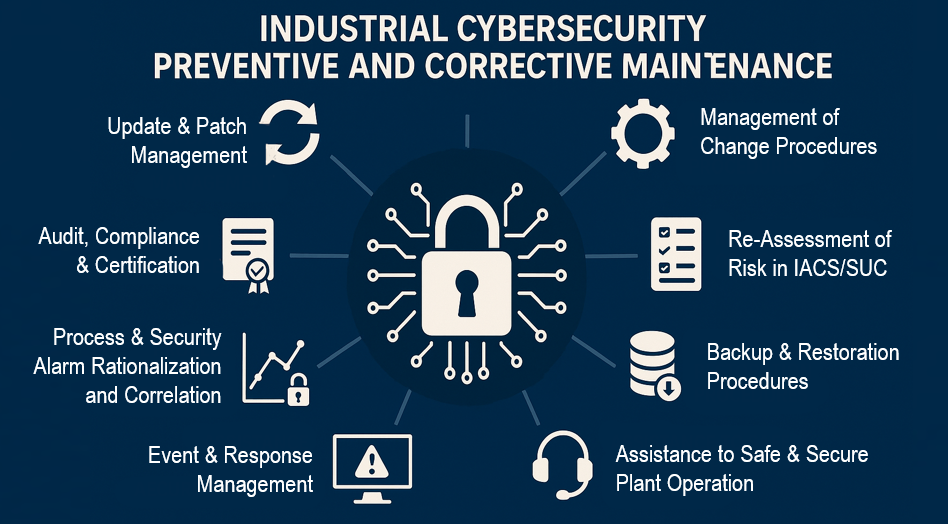

By formalizing preventive and corrective cybersecurity maintenance, industrial plants can reduce risk exposure, improve detection and response, and sustain operational trust in a connected world.
Category: Insights
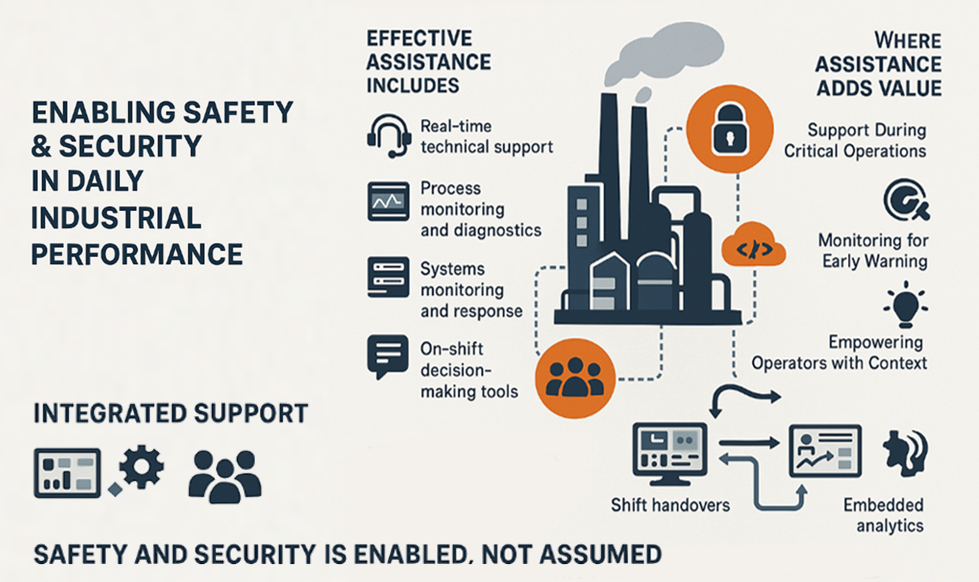
Supporting Safe & Secure Plant Operations
Become the bodyguard of the operators at the plant, helping them to keep focus where they need it. Avoid distractions and, at the same time, support their activities.
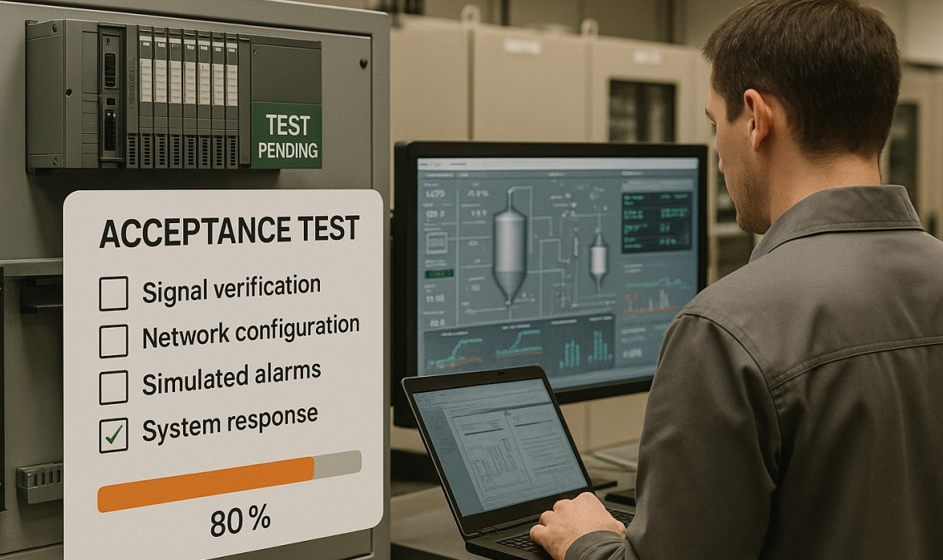
Security Acceptance Testing in Industrial Environments
The art of testing safety and security strategies to mitigate all intolerable risk that was identified suring the detailed risk assessment.
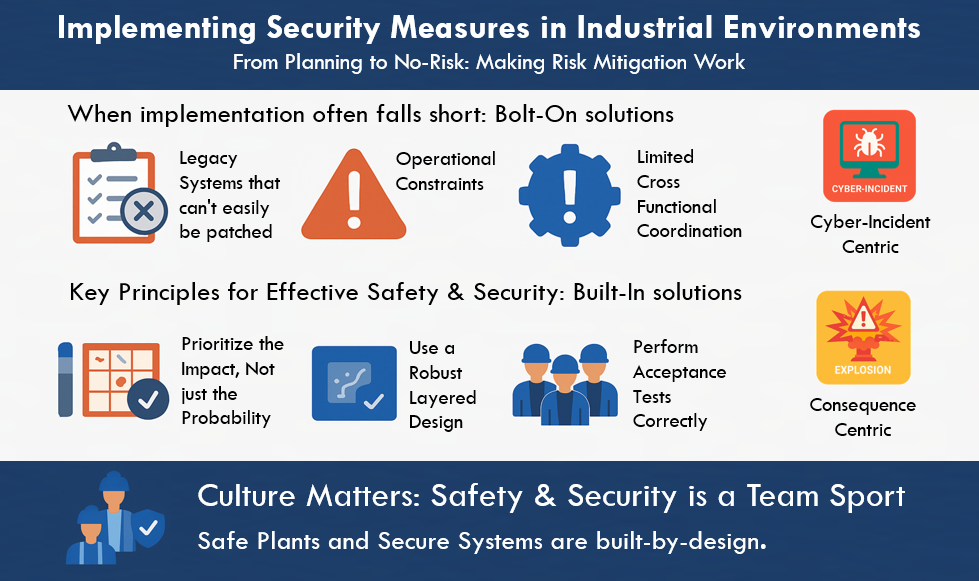
Implementing Safety and Security Measures in Industrial Environments
Move from Cyber-centric bolt-on to Consequence-Centric built-in solutions that works with the minimum budgets and long-term with the best ROI.
Designing Cybersecurity for Control Systems in Industrial Plants
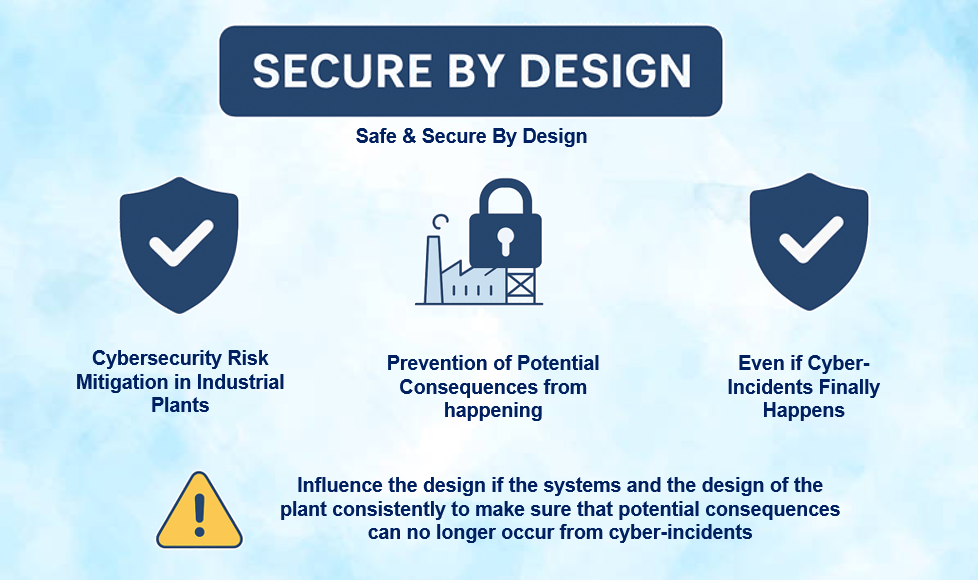
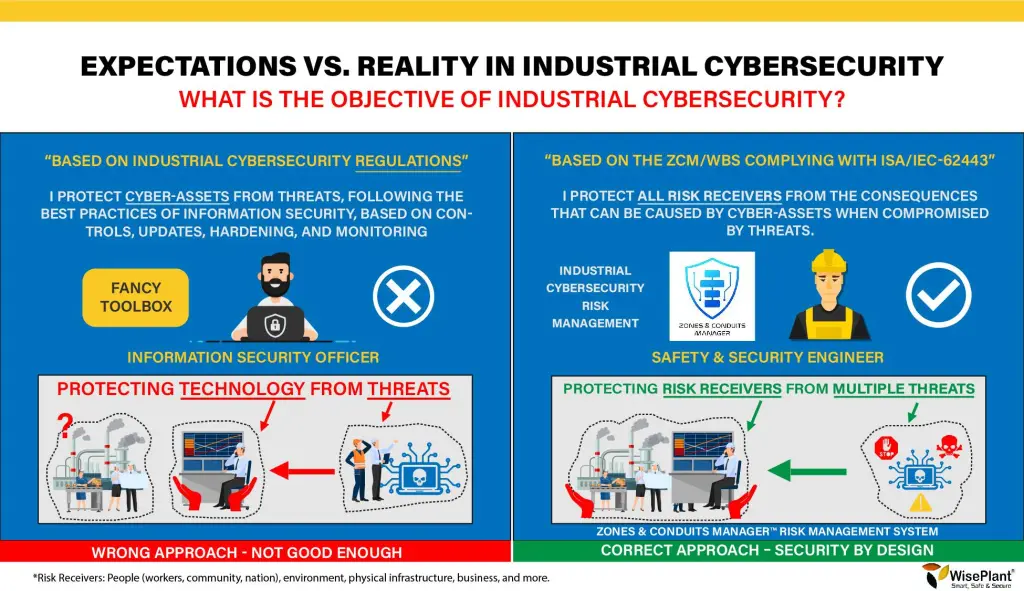
Secure By Design ensures that potential consequences cannot happen even if cyber-incidents finally happen, granting real risk mitigation.
Cyber Risk Analysis in Industrial Plants
Beyond Compliance: A Strategic Tool for Operational Technology
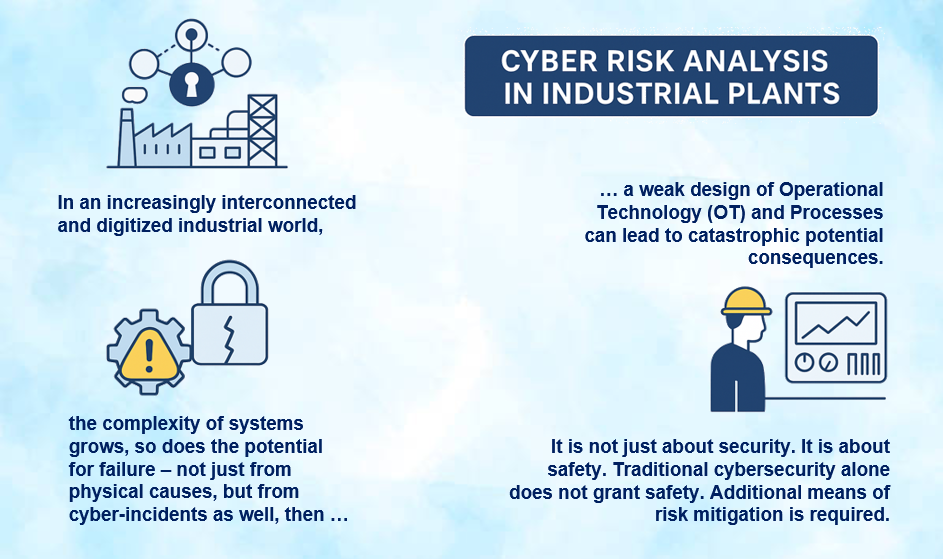
In an increasingly interconnected industrial world, Operational Technology (OT) has become the backbone of modern production. Yet, as the complexity of systems grows, so does the potential for failure—not just from physical causes, but from cyber-incidents as well.
Risk analysis, when viewed strategically, is no longer just about compliance. It’s a critical enabler of resilience, informed decision-making, and long-term operational sustainability.
Risk Analysis: From Obligation to Operational Compass
Risk assessments are often seen as mandatory exercises—conducted to satisfy regulators, check boxes, and pass audits. While compliance is important, this mindset limits the value of risk analysis.
When approached strategically, risk analysis serves as a compass rather than a constraint. It guides organizations through uncertainty, prioritizes what matters most, and helps align technical realities with business goals.
The Dual Nature of Risk: Physical Meets Digital
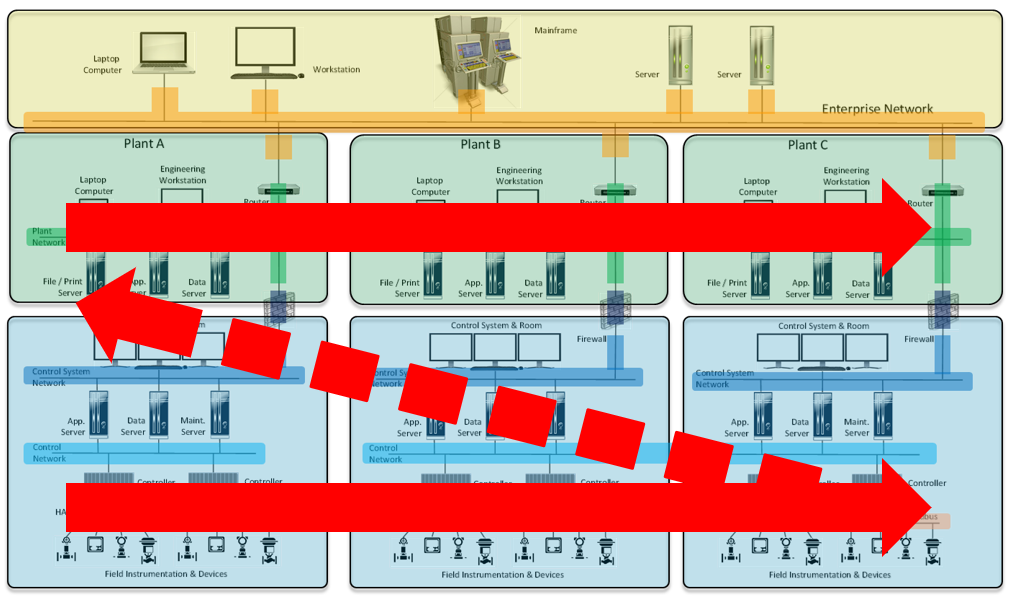
In industrial environments, risks come from both the physical and digital realms. Traditional failure modes—equipment breakdowns, human errors, and environmental hazards—remain relevant. But they now coexist with cyber risks: malicious actions, unauthorized access to control systems, configuration errors, and cascading effects from IT/OT convergence.
A compromised PLC or a misconfigured firewall can disrupt not only one machine, but an entire production line—or worse, introducing safety hazards and dangers.
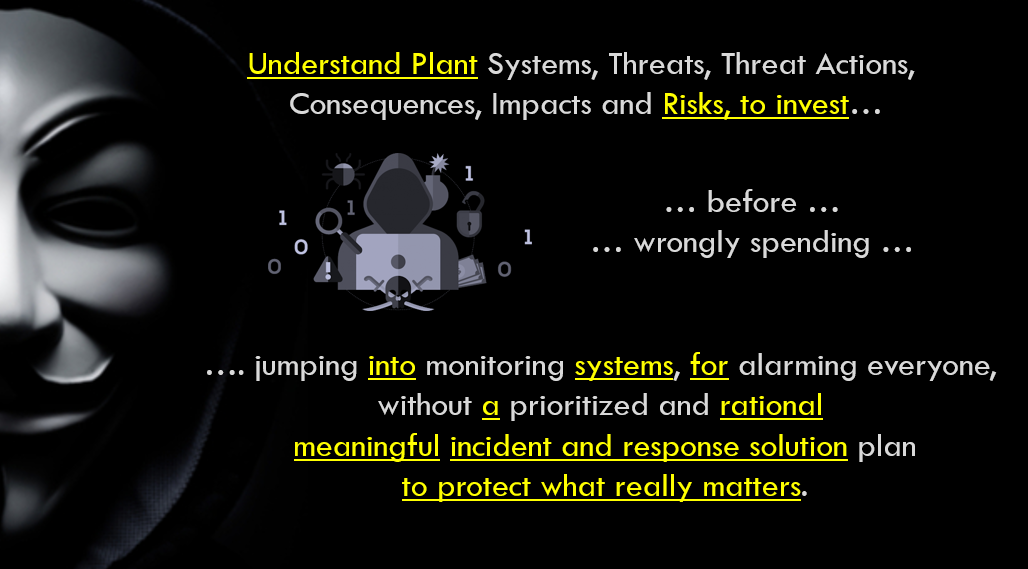
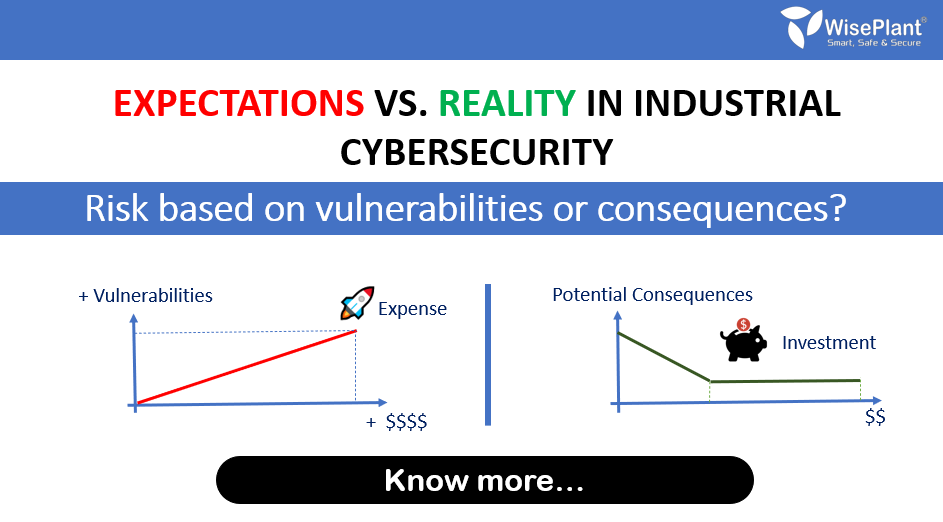
A true risk perspective must consider the full ecosystem, from the sensor on the plant floor. The consequence-centric methodology should be used to prevent potential consequences from happening, instead of a mere cyber-incident-centric. Cyber-Incident alone without potential consequences does not pose a risk to the plant.
Shared Ownership: Risk is Not Just for Safety or Security
Too often, risk analysis is siloed within safety, cybersecurity, or engineering departments. But in reality, risk touches every corner of the operation.
- Operations know where the production bottlenecks are.
- Maintenance understands the history of equipment failures.
- IT and OT teams grasp the digital infrastructure and its vulnerabilities.
When all stakeholders contribute to risk analysis, the result is more accurate, holistic, and actionable.
Prioritization is Strategic, Not Absolute
Not every vulnerability needs to be eliminated—nor can it be. The focus should be on evaluating risks based on operational impact, not just probability.
Consider this:
If this controller goes offline, what processes will be affected? What’s the potential downtime? What’s the risk to safety?
This approach connects technical risks to business operational outcomes, enabling better prioritization and investment in mitigation.
Conclusion: Risk as a Lever for Resilience
Risk analysis in industrial plants is far more than a compliance obligation. It is a dynamic tool for navigating complexity, enabling cross-functional collaboration, and strengthening operational agility.
Organizations that integrate risk thinking into their OT strategy are better prepared—not just to avoid failures, but to adapt, respond, and grow.
Let’s Open the Discussion
How is your organization approaching risk today?
Is it still an annual audit item—or is it evolving into a strategic function embedded in daily decision-making?
I’d love to hear your perspective. Feel free to comment or share your experiences.
ISA/IEC-62443 Applications Compliance
The ISA/IEC-62443 series of standards is developed on three main roles. These are (a) plant owner, (b) value-added service provider, and (c) component and system manufacturers. Each with different responsibilities, concerns, priorities and objectives.
Taking good decisions during a risk assessment
Many different methods are currently used to assess cyber risk in industrial systems. Only a few are a good decisions.
Security By Design in Industrial Cybersecurity
Security by design is one of the most important and fundamental activities during the process of implementing cybersecurity in industrial systems.
1. What is industrial Cybersecurity?
Learn about the importance of securing industrial networks and the challenges in implementing effective cybersecurity measures within industrial environments.
Episode 2 Clip 6 – Mastering risk analysis and cybersecurity in industrial automation.
In this video, an industrial cybersecurity expert discusses the differences between various cybersecurity standards such as ISA/IEC-62443, NIST, and NERC, emphasizing the unique advantages of the ISA/IEC-62443 standards in effectively mitigating risks. The speaker highlights the substantial costs of government regulations funded by taxes and argues for the efficiency of ISA/IEC-62443. Drawing from over a decade of experience, the expert shares insights on the importance of robust design and how a cybersecurity-focused approach has reshaped their perspective on industrial automation.
Episode 2 Clip 5 – Avoiding typical errors when doing industrial risk assessments.
This clip emphasizes the critical need for proper risk assessment in IT practices, discusses common mistakes like skipping risk assessment, using the wrong methodology, and highlights the importance of a consequence-based approach for preventing incidents effectively.
Episode 2 Clip 4 – Understanding the importance of ISA/IEC-62443 series of standards.
In “Episode 2 Clip 4,” the speaker discusses the best methodologies for evaluating industrial cybersecurity risks, emphasizing adherence to the ISA/IEC-62443-3-2 standard. Key points include the need for a multidisciplinary, knowledge-based approach, the importance of integrating cybersecurity with other risk management disciplines, and the dangers of relying too heavily on IT-centric solutions. The clip stresses the necessity of long-term, rational decision-making within the plant and illustrates the risks associated with external dependencies, using the CrowdStrike incident as an example. The aim is to guide professionals toward effective and sustainable cybersecurity practices for critical infrastructures.
Episode 2 Clip 3 – The formula for calculating cyber risk.
The clip discusses the challenges of calculating industrial cybersecurity risk, emphasizing the importance of understanding and effectively implementing risk formulas, highlighting the role of system design in preventing cyber incidents, and stressing the significance of informed decision-making and proper investment in cybersecurity solutions.
Episode 2 Clip 2 – The true goals of industrial cybersecurity.
This clip discusses the importance of industrial cybersecurity in preventing consequences rather than just incidents. It emphasizes the need for strategic management of risks to ensure plant safety and longevity, highlighting the key role of correctly implemented cybersecurity measures. The video also touches on calculating return on investment and the significance of maintaining a comprehensive cybersecurity strategy for overall business success.
Episode 2 Clip 1 – The importance of Risk Assessment.
This video cast focuses on the importance of risk assessment in industrial cybersecurity. The speakers discuss the significance of identifying and mitigating intolerable risks through proper risk assessment practices. They emphasize the different disciplines of risk present in typical plants and stress the need for accurate decision-making based on sound analysis.
Episode 1 Clip 6 – What are the best training courses or programs for End Users and Providers?
Emphasizes the importance of investing in cybersecurity training programs, particularly the official ISA certificate training and the WisePlant cybersecurity program. It highlights the need for understanding and implementing cybersecurity requirements correctly, tailored to individual roles. The training aims to ensure project success by aligning all participants towards a common goal in the cybersecurity field.
Episode 1 Clip 5 – What do you think is the most difficult challenge to manage or mitigate the industrial cybersecurity risk?
Discusses the challenges of managing industrial cybersecurity effectively, emphasizing the importance of doing the right things correctly. It highlights why companies struggle with implementing standards and how viewing cybersecurity as an investment, rather than an expense, is crucial for the long-term security and success of businesses.
Episode 1 Clip 4 – What are the most common mistakes that you’ve seen in the market so far?
Outlines common mistakes in industrial cybersecurity, including skipping risk assessments, copying IT security policies without adaptation, and relying solely on employee training. Practical advice is given on how to prevent these errors and improve cybersecurity practices.
Episode 1 Clip 3 – What is the best approach to address industrial cybersecurity?
Emphasizes the necessity of a continuous cultural change towards cybersecurity in industrial operations for end users, service providers, and manufacturers. It highlights the importance of implementing cybersecurity management programs, conducting risk assessments, mitigating risks, and maintaining long-term security measures across the entire supply chain.