

Building Resilience from the Inside Out
As industrial environments become more connected, the control systems that run critical infrastructure PLCs, SCADA, DCS are increasingly exposed to cyber threats. Yet many plants still treat cybersecurity as an add-on or many add-ons, applied after systems are built.
True cybersecurity needs a robust design. And in OT, that means embedding security into the architecture of control systems and the plant floor, not just around them.
Why Cybersecurity Can’t Be an Afterthought in OT
Historically, industrial systems were isolated. Air-gapped networks, proprietary protocols, and physical access controls were seen as sufficient protection. But that world no longer exists.
Today’s industrial control systems (ICS) are deeply integrated with IT, remote access, cloud platforms, and third-party services. This connectivity brings efficiency but also opens the door to vulnerabilities.
Designing security upfront allows us to address these risks without compromising performance or safety.
Principles of Secure OT System Design
Designing cybersecurity into ICS is not about installing more firewalls—it’s about making safety and security a core part of system engineering. Here are some key principles:
- Defense in Depth
Layered protections reduce the likelihood that a single failure leads to compromise. This includes:
- Network segmentation (e.g., separating IT and OT zones)
- Access control at both network and device levels
- Application whitelisting
- Physical security barriers
- Least Privilege & Role-Based Access
Only authorized personnel should have access to control functions, and only the access they need. Default credentials, shared logins, or overly broad permissions remain common and dangerous.
- Secure by Design, Not by Patch
OT systems often run for decades. Relying on patches and updates to secure them is unrealistic. Design choices should minimize the attack surface from day one.
Example: choosing hardware that disables unused ports, or software that can enforce encryption natively.
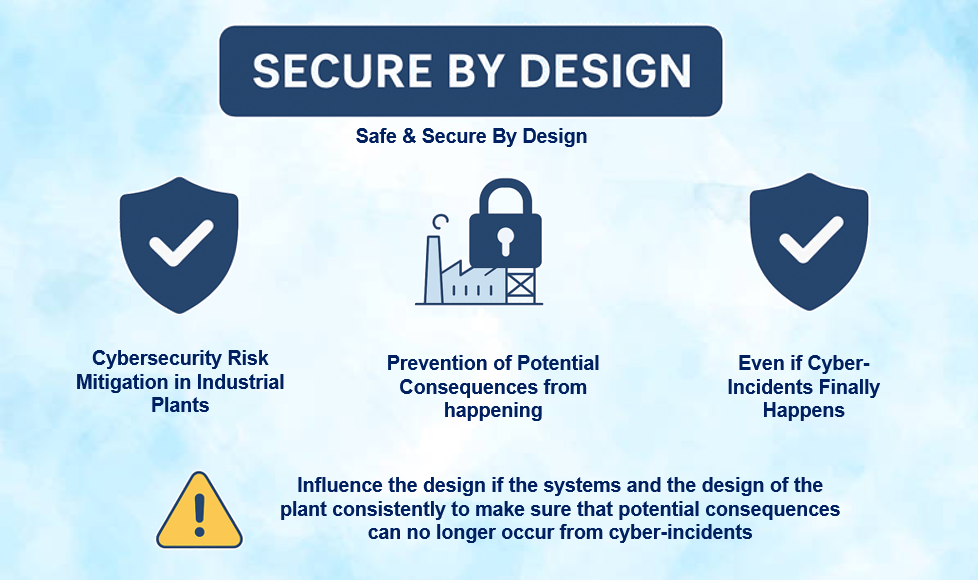
Secure By Design ensures that potential consequences cannot happen even if cyber-incidents finally happen, granting real risk mitigation, independently of the current and future vulnerabilities and threats to come.
- Monitoring and Detection
Security is not static. Real-time visibility into network traffic, device behavior, and anomalies helps detect threats before they escalate.
- Use OT-aware intrusion detection systems (IDS)
- Correlate events with realistic risk obtained during a risk assessment.
- Robust design with the correct countermeasures.
- Resilience and Recovery
Even potential consequences cannot happen; cyber-incidents may still occur. Build-in recovery procedures, backup strategies, and incident response plans that reflect the assistance to safe and secure operation strategies.
Bridging IT and OT: Collaboration is Critical
Cybersecurity in control systems can’t succeed in silos. IT teams bring expertise in tools and frameworks, but OT teams understand operational constraints, real-time requirements, and process safety.
Design must be a bottom up, from the plant floor, or inside-out, with both domains contributing from the start. In opposition to the outside-in or a mere perimeter approach just focusing on threats, vulnerabilities and patching.
Conclusion: Cybersecurity is a Design Decision
Protecting control systems in industrial plants isn’t just about responding to threats, it’s about designing for resilience.
By embedding cybersecurity principles into system architecture, organizations can:
- Mitigate risk with long-term actions
- Avoid expensive retrofits
- Improve operational trust and uptime
How are you approaching cybersecurity in your control systems?
Is it part of your design strategy or still seen as a separate function?
Let’s share ideas, experiences, and lessons learned.





Get Involved & Participate!
Comments