
From Planning to No Risk: Making Risk Mitigation Work
In the world of industrial operations, identifying risks is only the first step. The real challenge lies in turning assessments into concrete, effective, and efficient actions that protect both the most valuable assets and the uptime.
Security that lives only on paper is a vulnerability in itself. The difference between knowing and doing is where operational resilience is truly built.
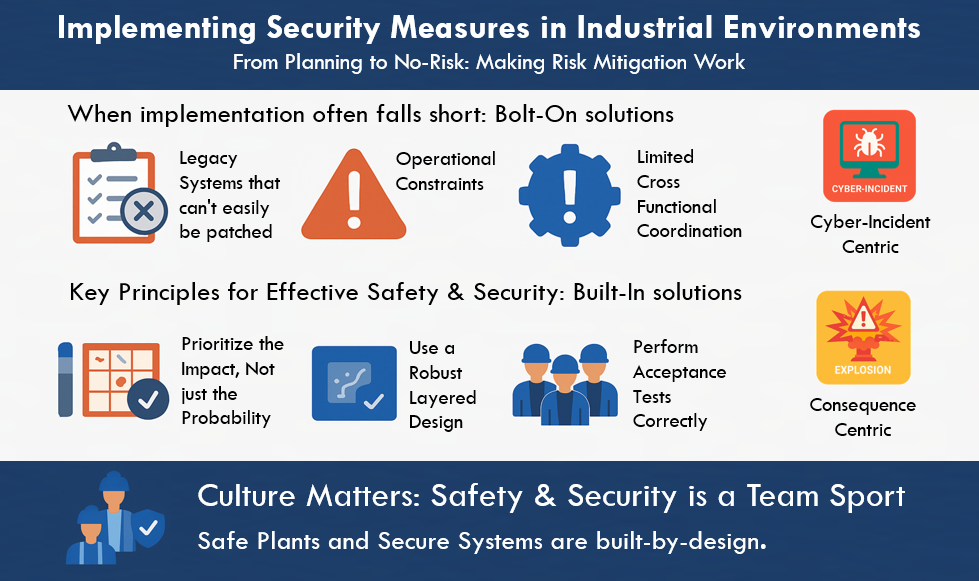
Why Implementation Often Falls Short
Industrial environments are complex. Implementing security measures faces several obstacles:
- Legacy systems that can’t easily be patched or updated.
- Operational constraints, where downtime is expensive or unsafe.
- Limited cross-functional coordination, leading to isolated efforts.
- Resource challenges: time, budget, skills.
- Ignoring the context: focus con preventing cyber-incidents alone.
The result? Well-documented risks that remain unmitigated—or mitigated in theory but not in practice.
Key Principles for Effective Security Implementation
To move from theory to practice, risk mitigation must be intentional, prioritized, and sustainable. Here’s how to make that happen:
- Prioritize by Impact, Not Just Probability
Not every risk is equal. Use the risk matrix from the plant that contains the knowledge and rules against consequence, especially in operational terms.
Ask: What’s the worst-case scenario if this system fails or is compromised?
Then: What’s the most effective action to eliminate that specific risk?
This helps focus on limited resources where they matter most. Prioritize, prioritize, and prioritize correctly.
- Integrate Security with Operational Workflows
Security actions must fit into existing industrial processes, not fight against them.
- Schedule updates and configuration changes during planned downtimes.
- Align access control procedures with maintenance operations.
- Automate what can be automated (e.g., credential rotation, log monitoring).
- Involve the real stakeholders, the people who knows more about the plant and the systems.
When security supports operations instead of disrupting them, adoption improves.
- Use Layered Design (Robust consistent design for safety and security)
Relying on a single measure—like a firewall—is not enough. Combine:
- Physical Layer – Safety (focus on preventing consequences)
- Technical Layer – Security (focus on preventing incidents)
- Governance Layer – Procedures (strong governance that makes sense)
Each layer compensates for the others, increasing the chance that even if one fails, the system holds. Focus on the consequences, not just cyber-incidents. Build a consequence-centric culture making sure that consequences can no longer occur even if cyber-incidents finally happen.
- Perform Acceptance Tests Correctly
Security is not a “do, believe and pray” task. Implementation needs to be verified and accepted:
- Are the changes in the design of the systems and the plant working as expected?
- Are you testing the correct scenarios aligned to the results of the risk assessment?
- Are teams following the procedures under real conditions?
Conduct Cyber-FAT and Cyber-SAT, to make sure that the systems, the plant and the governance were built according to the robust specifications. Don’t forget: The plant is not a game-zone to play war games with risky drills.
Culture Matters: Security Is a Team Sport
Even the best technical measures will fail if people bypass them. A strong security culture—where staff understands why controls exist and how to follow them—can’t be overlooked.
The Industrial Cybersecurity Risk is a problem of the plant. The plant must take ownership of the problem. If the plant is not deeply involved it won’t work. Many people wrongly believe that industrial cybersecurity is IT responsibility. Big mistake.
Training, communication, and involving operational teams in security planning are not optional. They’re strategic.
Conclusion: Safe plant and Secure Systems Are Built by Design—and Reinforced by Execution
Risk mitigation doesn’t end with documentation or false awareness (fear) campaigns. It comes to life through smart, operationally-aware implementation that balances protection with performance.
Organizations that invest in execution—not just planning—build plants and systems that are not only safe and secure, but resilient and adaptable in the log run.
How Do You Turn Plans into Action?
What’s your biggest challenge when implementing risk mitigation measures in OT?
Let’s share lessons learned and success stories—because in industrial security, practice makes protection.





Get Involved & Participate!
Comments