

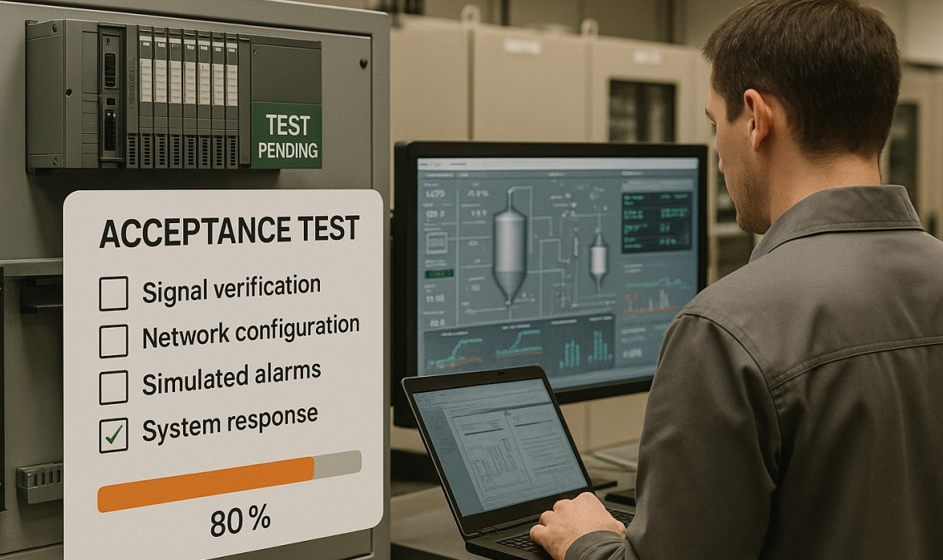
Verifying What Matters Before Going Live
In industrial control systems (ICS) and Operational Technology (OT), security is often treated as a design consideration or a compliance checkbox. But how do we verify that our security actually works—before it’s too late?
That’s where Security Acceptance Testing (SAT) comes in. It’s the final gate before deployment, ensuring that the implemented countermeasures are not only in place, but functioning as intended, under real-world conditions.
Why Security Testing Matters in OT
Unlike IT systems, industrial environments have unique constraints:
- Real-time operations
- Safety-critical processes
- Legacy equipment with limited support for modern controls
These constraints make it even more important to validate that security measures don’t just exist on paper, but are operationally effective and do not disrupt core processes.
SAT bridges the gap between policy and reality.
What Is Security Acceptance Testing?
Security Acceptance Testing is the process of verifying that all planned and implemented cybersecurity strategies meet the specified requirements before a system or asset is commissioned or goes live.
It typically includes:
- Verification of system hardening (e.g., disabled ports, secure configurations)
- Validation of access control (e.g., user roles, credential handling, logging)
- Functional testing of cybersecurity features (e.g., firewall rules, IDS alerts)
- Risk scenarios used during a Cybersecurity Risk Assessment
- Security processes and procedures
- Assessment of logging and monitoring
- Failover and recovery testing
The goal is to ensure that the system is secure, usable, and aligned with operational needs.
When and Where to Conduct SAT
Security Acceptance Testing should occur after system integration and before production rollout, in:
- New control system deployments
- Major upgrades or migrations
- Significant changes in architecture (e.g., network segmentation, remote access additions)
Ideally, tests are run in a staging environment that mimics production—or during scheduled downtime with rollback options.
When the system is already running at the plant – we call it and existing system – and changes are introduced for safety and security, these strategies, must also be tested or verified for acceptance purposes and operator training of the new functions.
Keys to Effective SAT in Industrial Settings
- Involve Cross-Functional Teams
Include OT engineers, cybersecurity specialists, automation vendors, and IT. Each brings a unique lens to the testing process.
- Use Realistic Test Scenarios
Test not just technical controls, but how systems behave under failure or attack scenarios (e.g., lost communication, invalid login attempts, network scan simulations).
- Document Everything
SAT is not just technical—it’s also evidence of due diligence. Use structured checklists and record results for compliance, audits, and future reference.
- Measure Both Security and Operational Impact
A secure system that disrupts operations is not a success. Evaluate whether security controls interfere with process availability or user workflows.
Conclusion: Trust, But Test
Security by design is powerful—but security by verification is essential. In OT environments, where downtime is expensive and safety is paramount, SAT gives teams the confidence that their security strategies won’t fail them when it matters most.
How Does Your Team Handle Security Testing?
Is Security Acceptance Testing a standard part of your OT projects?
Or is it still a gap in your deployment process?
Share your thoughts and let’s build a stronger culture of verification in the industrial sector.




Get Involved & Participate!
Comments