

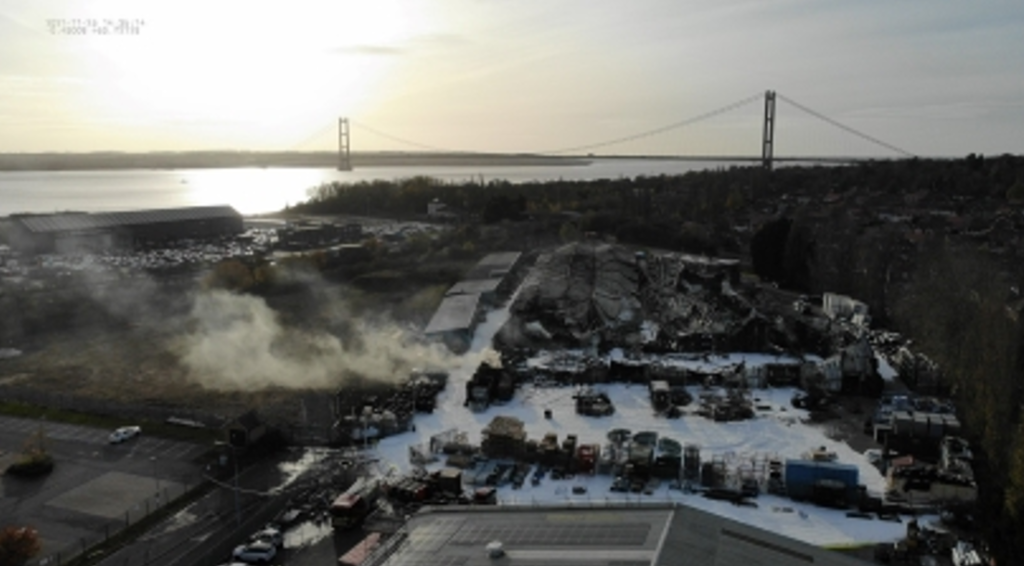
A major incident was reported in Hull, north-west England, on 24 November after a fire broke out in a factory containing around 300 tonnes of plastic. No one was injured during the incident; however, a response from several agencies was needed to address the fire, including 14 fire trucks and 70 firefighters.
The Humberside Fire and Rescue Service (HFRS) said it received an initial call at 15:30 local time to a fire at a plastic products’ factory belonging to Bridgewood UK. Working with partner agencies, HFRS was able to control the fire in the early hours of November 25. Around 300 tons of plastic were inside the factory at the time of the fire.HFRS said all staff were safely evacuated without injury or loss of life due to the result of the management team’s actions and processes implemented in the business.
A large plume of black smoke could be seen from across hull town throughout the afternoon, and some local residents shared images of black material that had bathed in the nearby area during the fire.
A major incident was later reported on the afternoon of November 24. Local residents at properties near the incident were evacuated as a precaution, with support from Humberside Police and local authorities. Residents were allowed to return to their properties in the early hours of Nov. 25. Humberside Police, the UK Health Safety Agency, Yorkshire Ambulance Service and the Environment Agency were at the scene and supported firefighters to control the blaze. As the large plume of smoke reduced to faint white smoke after using foam and water to extinguish the flames, HFRS reduced the number of fire trucks to six and remained on the scene to continue to dampen any waste heat and monitor the incident for the rest of the day.
Jason Kirby, Director of People and Development for the Humberside Fire and Rescue Service, said: “This is multi-agency work at its best; when the major incident was declared, we came together, and this resulted in us being able to quickly control this large industrial fire. More than 150 firefighters attended this incident, our fire control operators took 127 emergency calls to 999 in minutes and countless more internal communications while organizing the crew, working alongside colleagues from other agencies.”
“Our Prevention and Protection staff has visited the nearby residential area, bringing peace of mind to the community with residents of evacuated properties and those facing the fire, and the response has been astounding. Thank you for everyone’s support, encouragement and cooperation during this time.”
In the case of the massive fire involving 300 tons of plastic at a factory in Hull, United Kingdom, functional safety measures could have played a crucial role in preventing ignition, limiting escalation, and protecting personnel and assets. Here’s how:
Functional Safety Measures That Could Have Helped
| Safety Function | Purpose | SIL Target | Standard Reference |
|---|---|---|---|
| Combustible Gas & Smoke Detection | Detect early signs of combustion or vapor buildup in plastic storage zones | SIL 2–3 | IEC 61508 / IEC 61511 |
| Automatic Fire Suppression Systems | Activate foam, water mist, or inert gas systems to suppress fire rapidly | SIL 2 | IEC 61508 |
| Hot Work Permit Interlocks | Prevent unauthorized ignition sources during maintenance or welding | SIL 1–2 | ISO 13849 / IEC 61508 |
| Dust Collection & Explosion Venting | Control plastic dust accumulation and safely vent pressure in case of ignition | SIL 2–3 | NFPA 654 / IEC 61511 |
| Emergency Shutdown (ESD) Logic | Isolate power and flammable material feeds to prevent escalation | SIL 3 | IEC 61511 |
| Occupancy Detection & Alarm Systems | Alert and evacuate personnel from affected zones | SIL 1 | IEC 61511 / ISO 13849 |
| Safety Instrumented System (SIS) | Coordinate logic for detection, suppression, and shutdown | SIL 2–3 | IEC 61508 |
Key Risk Factors in Plastics Manufacturing
- Highly flammable materials (e.g., polyethylene, polypropylene)
- Dust explosion potential from plastic granules or powder
- Static discharge during material transfer
- Overheating of machinery or electrical faults
Takeaway
Functional safety isn’t just about compliance — it’s about engineering resilience into every layer of the operation. In high-risk environments like plastics manufacturing, early detection, automatic response, and fail-safe logic can mean the difference between a contained incident and a catastrophic fire.
Industrial Cybersecurity Measures That Could Have Helped
| Cybersecurity Control | Purpose & Benefit |
|---|---|
| Secure PLC & SCADA Configuration | Prevent unauthorized changes to fire detection, suppression, or ventilation logic. |
| Anomaly Detection Systems (ADS) | Identify unusual patterns in sensor data (e.g., sudden temperature spikes or gas buildup). |
| Network Segmentation (Zones & Conduits) | Isolate safety-critical systems from business networks to prevent lateral movement of threats. |
| Role-Based Access Control (RBAC) | Ensure only authorized personnel can override alarms or initiate manual shutdowns. |
| Secure Remote Access | Protect remote maintenance interfaces with multi-factor authentication and encryption. |
| Event Logging & Forensics | Maintain tamper-proof logs to trace root causes and detect cyber-physical interactions. |
Why It Matters
In plastics manufacturing, fire risks are amplified by flammable materials, dust accumulation, and static discharge. If cybersecurity is weak:
- Attackers or misconfigurations could disable fire detection or suppression systems.
- Malicious actors might override safety interlocks during maintenance.
- Compromised systems may fail to trigger alarms or shutdowns in time.
Cybersecurity ensures that functional safety systems remain trustworthy and responsive, especially during critical moments.
Source: Link


Get Involved & Participate!
Comments